
The first signs of impending changes in the e-commerce market are already making waves, specifically in the form of product updates from major American tech giants. We analyze these shifts and explain what they mean for the future. For over 15 years, Comsysto Reply has been implementing complex e-commerce solutions for clients across all industries. At the same time, we track and analyze relevant trends in our e-Commerce Lab to ensure we are ready for tomorrow's challenges today. We share our insights here – every Tuesday!
We previously wrote in a past newsletter issue about a potential revolution from the classic online shop toward agent-based solutions. This topic is currently evolving rapidly! The following updates from Google, Amazon, and OpenAI, which have been rolled out in recent weeks or are coming soon, allow us a more informed look into the future.
Google Shopping changes its approach to EANs
Google's product search will no longer provide exact results for EANs (Wikipedia) in the future (E-Commerce Magazin). It is unclear why Google has removed this feature. In any case, this adjustment has a significant impact on the business models of certain providers who rely on exact results from Google's product search for automated price comparisons or market analysis.
While it is pure speculation whether there is a causal link here, it is safe to assume that this feature was a highly valuable data source for the AI systems of some of Google's competitors. And that source is now becoming somewhat more proprietary.
Google Search provides AI-generated answers
A change that most readers have likely already noticed is the introduction of AI-generated results above Google search results for any query that sounds like a question. This has consequences for content marketing: it is becoming more difficult to drive users to your own website with valuable content to position your brand (E-Commerce Magazin). While it is likely that not all customers will be satisfied with the AI-based summary and will continue to use the search results further down to access sources directly, a noticeable portion of traffic from Google Search has already been lost. This effect is expected to intensify over the coming months as more and more users become accustomed to this information source.

Two-part article titles coming to Amazon Marketplace
But it’s not just Google making changes—naturally, when it comes to e-commerce, you should always keep an eye on Amazon as well. There is an adjustment on their marketplace that you should prepare for, as Malte Karstan explains on LinkedIn (to the post). Amazon is likely to introduce two-part product titles this year. The first main part of the title should contain factual information to identify the item, such as brand, product type, model, size, and variant. The secondary headline should then summarize selling points like features and unique selling propositions. It is easy to see that this is partly about improving data quality for Rufus, Amazon's AI shopping assistant. And Amazon definitely has the market power to enforce this, for example, if product placement in the marketplace depends on the quality of these structured descriptions.
OpenAI improves "shopping" in ChatGPT
There is also news from OpenAI! In the future, results for product-related searches will be displayed more attractively and similarly to the tiles common in e-commerce, as can be read in their blog (OpenAI).
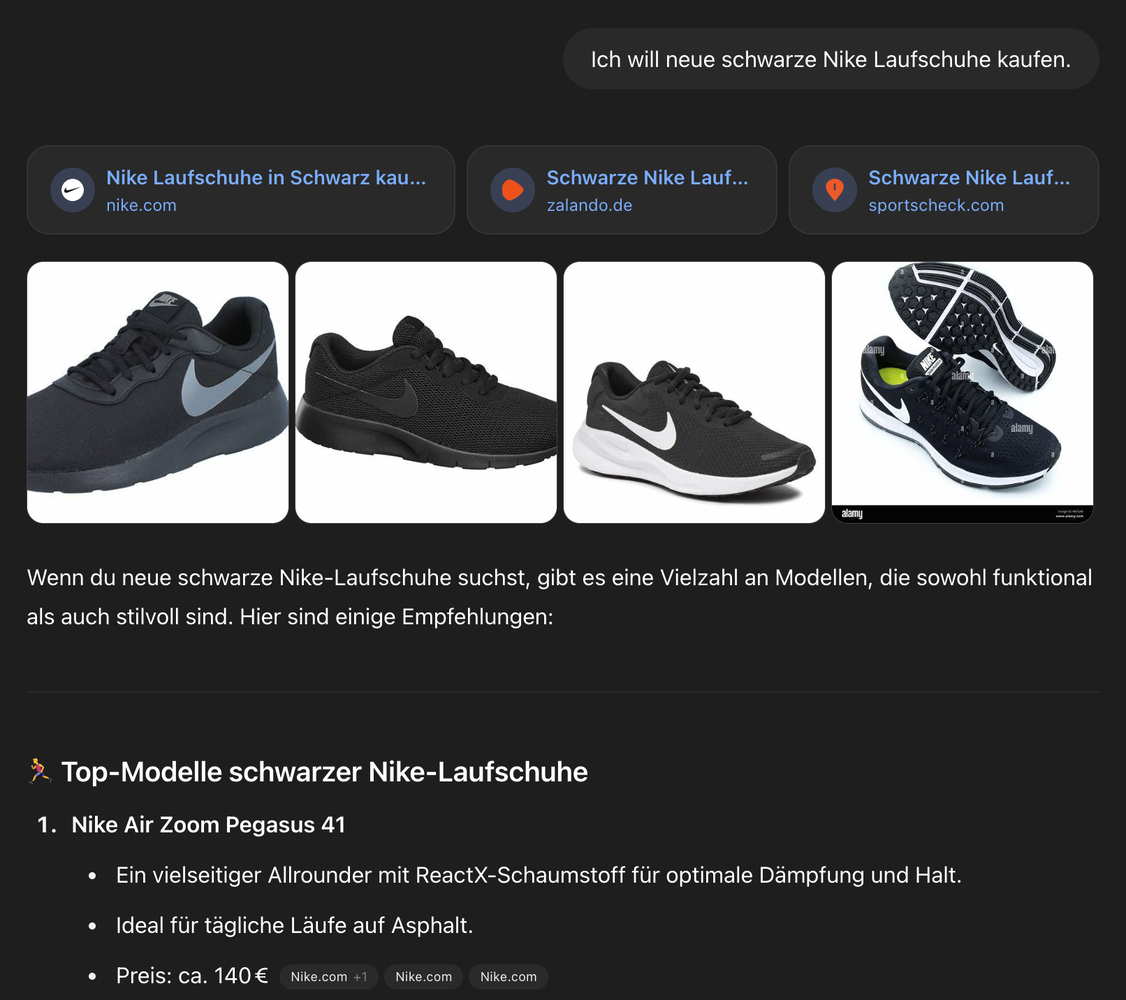
And that seems to be just the beginning – clues were apparently found in a part of OpenAI's publicly accessible source code that a deep integration with Shopify is planned (TestingCatalog). A lot of movement is to be expected in this area, especially after Microsoft also launched a direct integration of online retailers into its Co-Pilot app (Microsoft).
That’s it for today – and here’s what’s next
Even though few currently believe in the end of traditional storefronts (in my survey 2 weeks ago, it was less than 10%), they will face increasing competition from AI and conversational agents in the future. As always, disruptive changes start slowly – but once the wave becomes big enough, only those who jumped on early enough will be able to keep up.
Speaking of disruptive changes: These also occur in more specialized cases than the most prominent e-commerce examples like fashion or electronics. Next week, in cooperation with Spark Reply , we will take a look at the automotive industry and the future of digital car buying.
See you next week!
Christian & the Comsysto Reply e-Commerce Lab